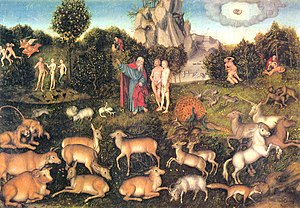
The Genesis account of the Creation and Fall, poetic and metaphysical, takes place in an archetypal landscape that lies behind our world and shapes it from within. In that sense, while we are conscious of the state of fallen nature, into which we have been exiled – it is evident in the facts of death and suffering and the weakness of our will – the archetypal landscape of Genesis is not entirely inaccessible. Chesterton speculated that the garden of Eden lies all around us still, only our eyes have changed so we cannot see it. There are some of the English mystics who have "cleansed their eyes" and seen paradise: Thomas Traherne, William Blake, and Samuel Palmer were among them. Traherne wrote: "Your enjoyment of the world is never right, till every morning you awake
Friday, 16 December 2011
Monday, 12 December 2011
The eyes of faith
The first volume of Hans Urs von Balthasar’s The Glory of the Lord lays the foundation for a recovery of the lost art of reading "objective symbolism" and thus the deeper meanings of Scripture. In it the history of the tradition of the spiritual senses – faith as a "theological act of perception" – is thoroughly explored, and the importance of its recovery for our time is explained. The weakness of Christianity after the Enlightenment is due very largely to the distortions induced by rationalism, sentimentalism, moralism, and voluntarism. Balthasar writes (p. 140) that the integration of the act of perception back into our understanding of faith
"is not only of theological and theoretical interest; it is a vital question for Christianity today, which can only commend itself to the surrounding world if it first regards itself as being worthy of belief. And it will only do this if faith, for Christians, does not first and last mean 'holding certain propositions to be true' which are incomprehensible to human reason and must be accepted only out of obedience to authority."For a generation unwilling to accept the truths of faith on the authority of tradition or of the Church, there has to be an act of seeing into the words of Scripture and the events of history, which reveals not merely the logical consistency of a Creed,
Saturday, 10 December 2011
The language of the heart
If this intuitive vision or “depth-perception” has been neglected, if we are living only on the surface of our faith, if we have not been listening enough to our poets and visionaries, we will find, as we are finding now, that the faith our ancestors professed is easily dislodged as tumbleweed. It has no deep root in us, for we have not grasped its significance as the key to understanding the world – even
Tuesday, 6 December 2011
Sacred Signs
The little book Sacred Signs by Romano Guardini is a model for a kind of mystagogical catechesis that is sorely lacking in today's Church. In order to appreciate the sacraments and sacramentals, we need to see that they employ a symbolic language that has much wider applications. This can help us see the whole world in a different way, as linked together not just by the causality investigated by modern science, but by analogies and resemblances that add other layers of meaning, and which speak of the "vertical causation" by which God reveals himself in creation. The translator of the book, Grace Branham, in her excellent Preface writes:
'Guardini's "Sacred Signs" was designed to begin our reeducation. It assumes that correspondence between man and nature, matter and meaning, which is the basis of the Sacramental System and made possible the Incarnation. Man, body and soul together, is made in the image and likeness of God. His hand, like God's, is an instrument of power. In the Bible "hand" means power. Man's feet stand for
Thursday, 1 December 2011
The three stages of Christian life
As I said at the end of The Seven Sacraments, "mystagogy" is the stage of exploratory catechesis that comes after apologetics, after evangelization, and after the so-called "sacraments of initiation" (Baptism, Eucharist, and Confirmation) have been received. Baptism and Confirmation may be given only once. Christian initiation, however, is a continuing adventure, since the grace of these sacraments is the source of a new life of prayer that must continue to grow, if it is not to wither and die.
One of the greatest of Christian masters of mystagogy, who wrote under a pseudonym around five hundred years after the birth of Christ, is Dionysius the Areopagite, sometimes called Saint Denys. His influence on Christian mysticism, art, and architecture (through, for example, the school of Chartres in eleventh century France) has been immeasurable, his orthodoxy assured by such admirers and interpreters as Maximus the Confessor in the East and Thomas Aquinas in the West.
Dionysius divided the Christian Way into three phases, which he called purification, illumination and union, and linked these to the three hierarchies of angels, who were thought to assist in each of these three phases—to put it
One of the greatest of Christian masters of mystagogy, who wrote under a pseudonym around five hundred years after the birth of Christ, is Dionysius the Areopagite, sometimes called Saint Denys. His influence on Christian mysticism, art, and architecture (through, for example, the school of Chartres in eleventh century France) has been immeasurable, his orthodoxy assured by such admirers and interpreters as Maximus the Confessor in the East and Thomas Aquinas in the West.
Dionysius divided the Christian Way into three phases, which he called purification, illumination and union, and linked these to the three hierarchies of angels, who were thought to assist in each of these three phases—to put it
Subscribe to:
Posts (Atom)


