Our human “problem” was defined very neatly by Father Vincent Nagel, a Palestinian Christian, in a meditation printed in
Magnificat for the 9th of March, looking at the reasons people have for acting as they do. “The problem is that we only have one heart, and in the end it can be attached only to one thing.” Most of us behave well and act piously merely so that others will think well of us. We are not really attached to God, but to our own image. “We have had our reward,” then, in this world, and cannot receive it in the next. That is why Jesus tells us to pray in secret, so that people cannot see us, but “your Father who sees all that is done in secret will reward you” (Matthew 6:6).
Jesus also tells us in the Sermon on the Mount that only the “pure in heart” will see God, which is how we describe the ultimate achievement of our life’s purpose in perfect happiness. But what is purity of heart? According to Soren Kierkegaard, “Purity of Heart is to Will One Thing”. If we investigate this notion a bit further, we find it provides the key to understanding the religious impulse. In The One and the Many, W. Norris Clarke SJ writes of Unity “as a positive energy by which each being actively coheres within itself holding its parts together – if it has any – in a dynamic, self-unifying act” (p. 63). This goes for atoms, it goes for living organisms, it goes for people. It even goes for God, where the “active divine energy of love that is the bond of unity between Father and Son” is the Holy Spirit.
Here is the lesson we can draw from this rather abstract idea: “to be anything real it is necessary to be one, integrated.” Religion is the striving for unity in the soul. This enables us to see the grain of truth in Gurdjieff’s teaching, because as Clarke says, “the unity of what is called our psychological ‘personality’ is not given to us ready-made. It is something we must work at and achieve by our own conscious action.” The transformation we are seeking is a unification of ourselves, such that we are no longer composed of bits pulling in different directions (Romans 7: “the good that I would I do not: but the evil which I would not, that I do”). Achieving such an integrated personality seems impossible. To this, Jesus replies, “With man this is impossible, but with God all things are possible” (Matthew19:26). Clarke answers that we must be unified by “one great love”.
Unity; “one-pointedness”; integrity; purity of heart; being “true” to ourselves. All these words and phrases refer to the same thing. Buddhism speaks of “mindfulness”. We can only become happy by becoming real, and we become real by becoming one. The missing element is “grace”. That is the thing or force that enables us to be transformed, to become real. We call it “becoming holy” or becoming a saint. Grace is “gift”, the help of the “Higher Power” as AA puts it. Grace is everywhere available from a loving God to anyone who opens himself or herself to receive it. That is the point of the sacraments – not that they automatically make us holy, but that through them, if we are receptive, we can obtain the grace we need.
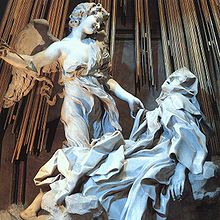
Illustration: "Prayer Without End" by Nicholas Maes (1656), Rijksmuseum, Amsterdam.