Showing posts with label Trinity. Show all posts

Sunday, 15 July 2012

3. Boehme's myth of the Trinity

Boehme described his great vision of 1600 in the work known as The Aurora (not published until 1656). While not, as I have said, a theological work, it contains the following fine description of the Christian Trinity:
“Now when we speak or write of the three Persons in the deity, you must not conceive that therefore there are three Gods, each reigning and ruling by himself, like temporal kings on earth.
No: such a substance and being is not in God; for the divine being consisteth in power, and not in body or flesh.
The Father is the whole divine power, whence all creatures have proceeded, and hath been always, from eternity: He hath neither beginning nor end.
The Son is in the Father, being the Father’s Heart or light, and the Father generateth the Son continually, from eternity to eternity; and the Son’s power and splendour shine back again in the whole Father, as the sun doth in the whole world.
The Son is also another Person than the Father, but not externally, without or severed from the Father, nor is he any other God than the Father is; his power, splendour, and omnipotence, are no less than the whole Father.
The Holy Ghost proceedeth from the Father and the Son, and is the third self-subsisting Person in the Deity.... he is nothing less or greater than the Father and the Son; his moving power is in the whole Father.”
John Sparrow’s seventeenth-century translation of The Aurora is reproduced in B. Nicolescu, Science, Meaning and Evolution (New York, Parabola Books, 1991).

God’s own nature, according to Boehme, is not the seemingly static perfection implied by medieval scholastic philosophy under the influence of the Greeks. It is a dynamic process, eternally fulfilled and complete in itself without the need of a creation. To create the world, according to Boehme, was therefore an act of divine freedom motivated by love alone. The world is “Magic”: an outbirth of God’s eternal nature formed by the divine Will through the Imagination. The Mirror of Wisdom contains all angels and souls as eternal “possibilities”. God imbues these with actuality through his Word (the Fiat lux: 'Let there be Light").

Boehme is neither a pantheist nor an emanationist: the world is not made out of “nothing”, but yet it is other than God. It is made out of the seven archetypal forces, the “seven spirits of God” that form the Heavenly Sophia; it is made out of Fire and Light woven together by divine Eros (“all things stand in the wisdom in a spiritual form in the attraction of the Fire and Light, in a wrestling sport of Love”).

The first strictly created reality is the Heaven of the Angels. Angelic life is a partial or derived eternity, free of space and time; it is not divided up into a succession of moments or locations but is simultaneous and everywhere present. (Martenson struggles with this idea, but it is simply a rediscovery of the medieval Catholic notion of the Aevum, an intermediary state between God’s eternity and our time.) The freedom of the Angels consists in the ability to choose between nature and grace – or, in Boehme’s terminology, to sacrifice the Wheel of Nature (self-centred existence) in the fourth natural energy for the sake of the Wheel of Light (the life of Love).

The Angel Lucifer “fell” by choosing to dwell in his own nature, and so the Fire was transformed not into Light but into Anguish. The Hell in which he suffers, and into which he drags the rest of creation, is caused not by God but by his own choice. (However, the possibility of Hell lies in the natural imperfection of a created reality, which must be distinct from eternity and therefore cannot be perfect in itself.)

Boehme believes that the Fall of Lucifer affected his entire subordinate kingdom, which happens to be the world of our own Earth, reducing this to a fiercely burning Chaos. It was the Fall that initiated the war of Light against Darkness that we call time and space. God’s merciful reaction to this first Fall was to submerge the Earth in water and begin a new creation. The process (recapitulated later in the story of the Flood) is described in the early chapters of the Book of Genesis – the account not of the first or Angelic creation but the re-creation from Chaos, and specifically the attempt to establish a new harmony based on Man.

Adam is made in God’s image, tripartite. He is body, soul and spirit; his body drawn from that created world that is a copy of Uncreated Heaven, his soul and spirit reflecting respectively the Father (Fire) and Son (Light). Even the human soul is tripartite, in that it can turn towards one or other of the three primordial worlds of the Ternary. Indeed, Man was created with a view to his becoming (in Christ) the Consummator of the creation and Mediator between heaven and earth. But to be made imperishable in blessedness and to bring the Light out of the Fire in himself he must first overcome temptation. This, as we know, he did not do. Time as we understand it – let us call it “entropic time”, meaning time that is measured by decay and death – began with the Fall of Man, as a secondary cycle of reparation and restoration centred on the Cross.

1. Jacob Boehme.
2. Boehme and the birth of God.

Friday, 13 July 2012

2. Boehme and the birth of God

Jacob Boehme’s visionary writings are not understood correctly when they are confused with philosophy or theology. He is making theological use of mythological and poetic speech. In his account of creation, he is describing structural elements that lie deep within the visible world, below the surface of nature; but he presents these as story, applying temporal categories to eternity and inventing mythical events within the life of God in a way that remains extremely hard to disentangle. Nor should we assume that Boehme, just because he may have been vouchsafed a vision of these things, was always correct either in what he saw or in the way he interpreted and expressed it. His work is a stylistic mess, and full of real or apparent self-contradictions. He was, after all, a cobbler not a trained theologian or writer. Yet his influence on subsequent thought was immense (see previous piece).

According to Boehme, cosmogony recapitulates theogony. That is, creation is preceded by, and echoes, the primordial “birth of God”. In a “beginning before the beginning”, there is only the primal Abyss or chasm of the Ungrund, containing the unoriginated divine Will. This Will generates a Son, and breathes forth its energies as a Holy Spirit. Of these three principles the first (unoriginated Will) is a principle of darkness or mysterious fire in the “Unground” of God’s mystery. The second (the Son) is a principle of light, corresponding to the Will’s apprehension of itself as truth. The third is a reconciling force, in which the previous two are united – the radiation of the fire in the light. Through this third principle, which describes the operation of the Holy Spirit, the fulness or content of the divine nature streams out into the void and (having, one supposes, nowhere to go) is “reflected back” from it as though in a mirror. To this illuminated reflection Boehme gives the name Sophia, Wisdom. At first no more than a dream of the divine Imagination, when clothed by the desire of God in an eternal, imperishable body she becomes “Uncreated Heaven”, the Kingdom of Beauty or Body of God in which his Glory is forever manifested.

Boehme supplies further detail concerning this "eternal construction" of Heaven, which is the model for all subsequent creation. The three divine operations (which we associate with the Ternary of Father, Son, and Spirit) establish a separation between darkness and light within the divine nature itself, whilst reconciling the two in an eternal harmony. As far as I can understand it, the dark or “Nature Will” consists of a dynamic tension of three archetypal forces or energies, which he calls Salt (contraction), Mercury (expansion) and Sulphur (rotation). This is the “Wheel of Life”. A fourth energy called the “Lightning Flash” marks the transition between darkness and light, or the point where divine Love overcomes the darkness of the wheel, transfiguring it into a Light or Spirit Will consisting, again, of three energies (making seven in all). Contraction becomes the vital fluid symbolically called “Water”, expansion becomes “Sound” (vibration or rhythmic motion), and rotation becomes the “Essence” integrating both, for which a better term might be “Music” – music being, as Bishop Martenson suggests in his commentary, the best earthly symbol for the Kingdom of God.

In language that is less alchemical and more theological, one might say that the Trinitarian Will of God has entered into the knowledge of itself by reconciling in Love the otherness of Father and Son. God eternally “becomes” what he eternally already is: a Trinity of Persons enthroned in an Uncreated Heaven full of peace and beauty.
Illustration from Wikipedia Commons: Boehme's Cosmogony, "The Philosophical Sphere or Wonder Eye of Eternity" (1620).

Monday, 4 June 2012

Do Christians and Muslims worship the same God?

Yesterday was Trinity Sunday. Christians love a God who is Trinity, who was born of Mary, who died on the Cross for us, Muslims a God who is and did none of these things. How then can they be said to worship the same God? Yet the word "Allah" simply means "God", in Arabic. God is the supreme being, the One to whom our service and love is due, who made all things.

It seems clear that someone whom two neighbours know as "Jones", who lives in the house on the hill, is the same person, even if each of them knows different things about him, or knows him differently. Each has a drawer full of letters from

Friday, 11 May 2012

Theological manifesto

A new book by Fr Aidan Nichols is liable to be overlooked because he writes so many, but all are worthwhile, and this one is a kind of theological manifesto, a summary of his metaphysical and theological vision for the renewal of the Church. He explains that it is intended to offer "a fresh approach to the Catholic understanding of the world and human existence in revelation’s light." It ends with words that show where it has been leading us all along: "It is in letting the soul, the microcosm, and the world, the macrocosm, be the receptacle for all the generosity the Trinity pours forth that the Chalice of God fills to the brim." You can read a review here and a sample here. Fr Nichols has written an introduction to the book here.

Sunday, 25 December 2011

"On earth as it is in heaven"

The Lord's Prayer itself is composed of eight elements, the first of which invokes the Father, the remainder consisting of seven petitions. The first three elements in fact invoke all three persons of the Holy Trinity, as St Maximus explains:
"The words of the Lord's Prayer point out the Father, the Father's name, and the Father's kingdom to help us learn from the source himself to honour, to invoke, and to adore the one Trinity. For the name of God the Father is the only-begotten Son, and the kingdom of God the Father is the Holy Spirit."
If the "name" is the Son, then when the Lord tells Moses (Numbers 6: 22-7) to "call down my name on the sons of Israel" and bless them with the words, "May the Lord let his face shine on you and be gracious to you", he is instructing them

Thursday, 10 November 2011

Trinitarian Man

What is man? For Descartes, and for most of us unconsciously, man is a compound of body and soul; that is, a body and various mental states and faculties uneasily stitched together. But the traditional conception of man is rather more sophisticated, and needs to be recovered. We see a reference to it in St Paul’s first letter to the Thessalonians (5:23): “spirit and soul and body”.

Cardinal Henri de Lubac devoted a long essay to the development and subsequent neglect of Pauline tripartite anthropology in the Christian West (it can be found in the volume Theology in History, published by Ignatius Press in 1996).

Wednesday, 11 May 2011

Meister Eckhart

The German mystic Meister Eckhart is often viewed with suspicion by orthodox Catholics, and cited with approval by those who think he overcame the limitations of Christian dogma and made common cause with his fellow mystics in other religions.

The reason why Eckhart often reads like a heretic is that he was concerned to express not our own knowledge as individual creatures, but the divine knowledge itself, basing himself in the “ground” of the soul. As he says, “only in the ground of the soul is God known as he is,” for there “the intellect knows as it were within the Trinity and without otherness”. This possibility of knowing God “as God knows God” is opened to man by the Hypostatic Union of divine and human natures in Christ. C.F. Kelley’s Meister Eckhart on Divine Knowledge (Yale University Press, 1977) is a masterly study of exactly this point. As Kelley explains:
“A genuine understanding of the principial mode, which is constituted as it were within Godhead, is an understanding of truth that is beyond the potentiality of human cognition, restricted as that cognition is to individuality. Insight into this truth is a possibility only by way of transcendent act, never by way of potentiality. Yet the revelation of the Word is that transcendent act as assented to by the intellect when moved by the detached will to know.” 
When the perennialist Alvin Moore Jr reviewed Kelley’s book some years ago in Studies in Comparative Religion, he noted with stern disapproval the fact that Kelley (in Eckhart’s name) “equates the Godhead with the Trinity, sachchidananda with nirguna Brahman.” This goes to the heart of the matter. Kelley refuses, in his interpretation of Eckhart, to follow Schuon’s distinction between Being and Beyond-Being (that is, between the “relatively” Absolute and the “absolute” Absolute, thus relegating the Trinity to a subordinate status), or the related distinction between form and substance in the religions which underpins The Transcendent Unity of Religions.

Kelley’s exposition hinges instead on esse or Being, which he translates as isness, the “act or isness of pure knowledge itself, or Godhead”, the “all-inclusive Reality” (p. 42). He even cites Dionysius in support of Eckhart: “We apply the titles of ‘Trinity’ and ‘Unity’ to that which is beyond all titles, designating under the form of Being that which is beyond Being” (p. 30). Kelley means by all this that the Trinity is not, as Schuon would say, simply the “prefiguration of Manifestation in the Principle”, or the relatively Absolute which stands at the summit of Maya, but is itself the unconditioned Absolute about which “nothing can be said” – save what God authorizes us to say. I have written further about this in "Trinity and Creation: An Eckhartian Perspective".

Also recommended is Cyprian Smith OSB, The Way of Paradox (DLT) and Commentaries on Meister Eckhart Sermons by Sylvester Houedard OSB.

Thursday, 5 May 2011

Christian non-dualism

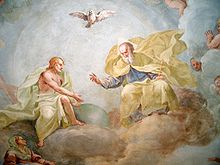
Two men and a bird...? Images of the Trinity are not uncommon in Christian art, but they have all to be taken with a pinch of salt.

The Trinity is one of the distinctive doctrines of Christianity. It goes hand in hand with the doctrine of the Incarnation, since if Jesus Christ was God, and at the same time the Son of God, there must be a distinction between God and God. The implications were worked out several centuries after the resurrection and ascension of Christ, giving Unitarians the opportunity to argue that the doctrine was a mere human invention. I think it can be shown that Scripture does imply and even teach the Christian Trinity. But does the doctrine make sense, metaphysically? As I wrote previously, the Sufi author of The Transcendent Unity of Religions, Frithjof Schuon, does not think so.

Schuon writes in Christianity/Islam (p. 97): “what Islam blames Christianity (not the Gospels) for is not that it should admit of a Trinity within God, but that it should place this Trinity on the same level as the divine Unity; not that it should attribute to God a ternary aspect, but that it should define God as triune, which amounts to saying either that the Absolute is triple or else that God is not the Absolute.”

But if this is what Islam thinks, then Islam blames Christianity for a sin it does not commit. The Church teaches that the Absolute is both One and Three, but not in the numerical sense, not “triple”, as if one could place the three Persons side by side and count them. As Meister Eckhart writes in his Commentary on Exodus, “God is one, outside and beyond number, and is not counted with anything”, and adds that in the Godhead “the same essence and the same act of existence which is the Paternity is the Sonship: the Father is what the Son is. Nevertheless, the Father himself is not the Person who is the Son, nor is the Paternity the Sonship.” Eckhart’s teaching is implied in this simple statement by St Augustine, cited by Joseph Ratzinger in his classic Introduction to Christianity (p. 183): “He is not called Father with reference to himself but only in relation to the Son; seen by himself he is simply God.” The Trinity is not a view of God from the outside – despite its symbolic depiction in Christian art – but is a secret of his interior life, of his relations with himself.

Islam’s inability to grasp all this is, of course, perfectly understandable. It cannot be grasped. We cannot “know” the Trinity, for the Trinity itself is something we can only accept in faith as Eckhart did, by assenting to the revelation of the Word. If a Muslim assented to that revelation, he would become a Christian. We can never get “outside” the Trinity in order to grasp it as an object. It is within the Trinity that we ourselves are grasped and understood, and “then I shall understand fully, even as I have been fully understood” (1 Cor. 13:12), but not otherwise.

If you like, read my "Face to Face: The Difference Between Christian and Hindu Non-Dualism".

Illustration: Holy Trinity, by Luca Rossetti da Orta, 1738-9, from Wikimedia.

Tuesday, 26 April 2011

Sherrard's critique of Rene Guénon

The late Philip Sherrard, a Perennialist and member of the Greek Orthodox Church, devotes a long chapter in his last book, Christianity: Lineaments of a Sacred Tradition, to the “Logic of Metaphysics in René Guénon” – although the points he makes are just as applicable to Schuon, as we shall see. Guénon did more than anyone else to reawaken metaphysical perception in our century, Sherrard says. But he made two important assumptions that predisposed him against Christianity and towards Vedanta (and which help to explain his own conversion from Catholicism to Islam). The first of these assumptions was that a strict correlation must be preserved between the metaphysical and the logical order – thus ruling out in advance the more paradoxical Christian relationship between Unity and Trinity in the Godhead. The second assumption was that every “determination” of the Absolute must be some form of limitation, and is therefore incompatible with the divine nature. These two assumptions led Guénon into an apophaticism so radical that he could affirm nothing at all of the Absolute, except by way of negation – including, obviously, a negation of the Christian Trinity.

Before his death, then, Sherrard had come to the conclusion that a Christian thinker who accepts Revelation must start from an entirely different point of view – must begin, in fact, from the knowledge that the supreme Principle is the Trinity, and furthermore that “personality” (indeed, triple Personality) in God is not necessarily a limitation. Without it, in fact, the Absolute has no actual freedom to determine itself or create a world: the freedom of God becomes merely the absence of external constraint. Although Sherrard assumes Schuon’s “transcendental unity” approach throughout his book, this insight calls into question one of Schuon’s core teachings: that a personal (or Tri-Personal) deity derives from an impersonal Godhead and will be “dissolved” in the gnosis which transcends Being. (As Sherrard writes, “This view thus involves a total denial of the ultimate value and reality of the personal. It demands as a condition of metaphysical knowledge a total impersonalism – the annulment and alienation of the person.”)

Sherrard’s insight leaves the other religions intact. It even leaves open the possibility that the perennialists have correctly understood them. But it separates Christianity, and perhaps even raises Christianity above them, in a way that seems to me incompatible (more so than he himself realized) with the theory of “transcendental unity” as stated by Schuon. Catholic theologian Hans Urs von Balthasar, for one, believes that what Christians have to say is not something less than, say, Vedanta or Sufism, but more. In fact “the Christian is called to be the guardian of metaphysics for our time”. Of one exemplary Christian mystic he writes: “Looking into his own ground, Jan van Ruysbroeck sees beyond it into the eternal I, which for man is both the source of his own I as well as his eternal Thou, and in the final analysis this is because the eternal I is already in itself I and Thou in the unity of the Holy Spirit” [Glory of the Lord, V, p. 70]. The encounter with God in this “ground” is a nuptial encounter, a spiritual marriage. Thus “The pantheistic tat tvam asi, which identifies subject and object in their depths, can be resolved only by virtue of the unity between God and man in the Son, who is both the ars divina mundi and the quintessence of actual creation (see Book III of Nicolas of Cusa’s [De] Doctor Ignorantia), and by virtue of the Holy Spirit, who proceeds from this incarnate Son in his unity with the Father” [GL, I, 195].