Showing posts with label creation. Show all posts

Wednesday, 18 July 2012

Infinity

The mathematician George Cantor (d. 1918) uses the word infinite to refer to a number defined as being greater than any finite number. In this sense of the word, the number of whole integers and the number of rational fractions are both “infinite” in the same degree. This is because for every fraction, no matter how many there may be of them, a new integer can always be assigned to it without ever running out of integers, and vice versa. In other words, you can use whole integers to number each item in a series of fractions.

The irrational numbers are rather different. Both integers and rational fractions of integers possess an inherent “graininess” because they are essentially definite, i.e. discontinuous with each other. Irrational numbers, on the other hand, occupy the spaces between each of the rationals, and fill them up continuously. The number of irrationals always exceeds that of the rationals, and therefore, according to Cantor, the “infinity” of the irrationals is of a different order.

The discovery of orders of infinity is highly significant for us. In fact Cantor’s set theory proves that there is an infinite series of infinities, each of a higher order than the last, right up to an “absolute” infinite, which he seems to have identified with God. As he wrote: “The fear of infinity is a form of myopia that destroys the possibility of seeing the actual infinite, even though it in its highest form has created and sustains us, and in its secondary transfinite forms occurs all around us and even inhabits our minds.”

Sunday, 15 July 2012

3. Boehme's myth of the Trinity

Boehme described his great vision of 1600 in the work known as The Aurora (not published until 1656). While not, as I have said, a theological work, it contains the following fine description of the Christian Trinity:
“Now when we speak or write of the three Persons in the deity, you must not conceive that therefore there are three Gods, each reigning and ruling by himself, like temporal kings on earth.
No: such a substance and being is not in God; for the divine being consisteth in power, and not in body or flesh.
The Father is the whole divine power, whence all creatures have proceeded, and hath been always, from eternity: He hath neither beginning nor end.
The Son is in the Father, being the Father’s Heart or light, and the Father generateth the Son continually, from eternity to eternity; and the Son’s power and splendour shine back again in the whole Father, as the sun doth in the whole world.
The Son is also another Person than the Father, but not externally, without or severed from the Father, nor is he any other God than the Father is; his power, splendour, and omnipotence, are no less than the whole Father.
The Holy Ghost proceedeth from the Father and the Son, and is the third self-subsisting Person in the Deity.... he is nothing less or greater than the Father and the Son; his moving power is in the whole Father.”
John Sparrow’s seventeenth-century translation of The Aurora is reproduced in B. Nicolescu, Science, Meaning and Evolution (New York, Parabola Books, 1991).

God’s own nature, according to Boehme, is not the seemingly static perfection implied by medieval scholastic philosophy under the influence of the Greeks. It is a dynamic process, eternally fulfilled and complete in itself without the need of a creation. To create the world, according to Boehme, was therefore an act of divine freedom motivated by love alone. The world is “Magic”: an outbirth of God’s eternal nature formed by the divine Will through the Imagination. The Mirror of Wisdom contains all angels and souls as eternal “possibilities”. God imbues these with actuality through his Word (the Fiat lux: 'Let there be Light").

Boehme is neither a pantheist nor an emanationist: the world is not made out of “nothing”, but yet it is other than God. It is made out of the seven archetypal forces, the “seven spirits of God” that form the Heavenly Sophia; it is made out of Fire and Light woven together by divine Eros (“all things stand in the wisdom in a spiritual form in the attraction of the Fire and Light, in a wrestling sport of Love”).

The first strictly created reality is the Heaven of the Angels. Angelic life is a partial or derived eternity, free of space and time; it is not divided up into a succession of moments or locations but is simultaneous and everywhere present. (Martenson struggles with this idea, but it is simply a rediscovery of the medieval Catholic notion of the Aevum, an intermediary state between God’s eternity and our time.) The freedom of the Angels consists in the ability to choose between nature and grace – or, in Boehme’s terminology, to sacrifice the Wheel of Nature (self-centred existence) in the fourth natural energy for the sake of the Wheel of Light (the life of Love).

The Angel Lucifer “fell” by choosing to dwell in his own nature, and so the Fire was transformed not into Light but into Anguish. The Hell in which he suffers, and into which he drags the rest of creation, is caused not by God but by his own choice. (However, the possibility of Hell lies in the natural imperfection of a created reality, which must be distinct from eternity and therefore cannot be perfect in itself.)

Boehme believes that the Fall of Lucifer affected his entire subordinate kingdom, which happens to be the world of our own Earth, reducing this to a fiercely burning Chaos. It was the Fall that initiated the war of Light against Darkness that we call time and space. God’s merciful reaction to this first Fall was to submerge the Earth in water and begin a new creation. The process (recapitulated later in the story of the Flood) is described in the early chapters of the Book of Genesis – the account not of the first or Angelic creation but the re-creation from Chaos, and specifically the attempt to establish a new harmony based on Man.

Adam is made in God’s image, tripartite. He is body, soul and spirit; his body drawn from that created world that is a copy of Uncreated Heaven, his soul and spirit reflecting respectively the Father (Fire) and Son (Light). Even the human soul is tripartite, in that it can turn towards one or other of the three primordial worlds of the Ternary. Indeed, Man was created with a view to his becoming (in Christ) the Consummator of the creation and Mediator between heaven and earth. But to be made imperishable in blessedness and to bring the Light out of the Fire in himself he must first overcome temptation. This, as we know, he did not do. Time as we understand it – let us call it “entropic time”, meaning time that is measured by decay and death – began with the Fall of Man, as a secondary cycle of reparation and restoration centred on the Cross.

1. Jacob Boehme.
2. Boehme and the birth of God.

Monday, 9 April 2012

Fire and light

The Pope's homily at the Easter Vigil on 7 April 2012 was about fire and light. As a great mystagogical teacher, Pope Benedict was not about to repeat platitudes. There was nothing trite about his exposition in this, surely one of the most striking homilies of his pontificate. "Whoever is close to me is close to the fire," said Jesus, according to Origen. The light of Christ is not a cold light but a warm one, the light of love, only harmful to those who reject it and do not welcome it into their own hearts. Fire is "the force of transformation", the Pope reminds us. For good reason it is associated with baptism, which the ancients called photismos, "illumination". The newly-baptized enter into a new day, a day of "indestructible life", which they see with the eyes of faith opened in them by the grace of God.

The Easter vigil begins at night with a bonfire, with the sanctification of the fire in the name of the God who through his Son "bestowed on the faithful the fire of [his] glory," and with one great candle lit from the same fire to represent Christ, the Light of the World. This is incised with symbols for the beginning, middle, and end of the cosmos, and "wounded" in the shape of a  cross by five grains of incense, before being carried in procession back into the church to stand at the altar throughout the Easter season.

The candle's light represents the beginning of the world, made out of nothing, to which the faithful bear witness. "Let there be light." The Prologue of John's Gospel takes up the tale of creation from Genesis. In Christ the world was made; and now in Christ it is made new. But why, in Genesis, are the sun and moon made later than the light? Of course, today we know that electromagnetic radiation (including light) was born billions of years before the sun and moon, but Genesis is not a scientific treatise, and the author was getting at another kind of truth. The Pope explains that by relegating them to the fourth day, the "divine" character of the heavenly bodies was removed and all things subordinated to the true light "through which God’s glory is reflected in the essence of the created being". Light is the revelation of truth, of goodness – the glory of God.
To say that God created light means that God created the world as a space for knowledge and truth, as a space for encounter and freedom, as a space for good and for love. Matter is fundamentally good, being itself is good. And evil does not come from God-made being, rather, it comes into existence through denial. 
After the night of death, the eyes of Jesus open once more upon the world. "Life is stronger than death. Good is stronger than evil. Love is stronger than hate. Truth is stronger than lies." The candle "is a light that lives from sacrifice. The candle shines inasmuch as it is burnt up. It gives light, inasmuch as it gives itself." And the light shed by Christ is the self-giving of divinity, of perfect love, which reveals reality as it truly is, in the mind of God.

Illustrations from www.paschalmystery.org, and William Blake.

Friday, 16 December 2011

Seeking the face of God

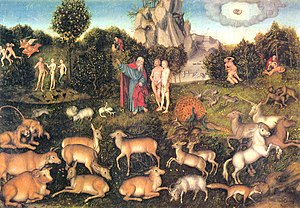
The Genesis account of the Creation and Fall, poetic and metaphysical, takes place in an archetypal landscape that lies behind our world and shapes it from within. In that sense, while we are conscious of the state of fallen nature, into which we have been exiled – it is evident in the facts of death and suffering and the weakness of our will – the archetypal landscape of Genesis is not entirely inaccessible. Chesterton speculated that the garden of Eden lies all around us still, only our eyes have changed so we cannot see it. There are some of the English mystics who have "cleansed their eyes" and seen paradise: Thomas Traherne, William Blake, and Samuel Palmer were among them. Traherne wrote: "Your enjoyment of the world is never right, till every morning you awake

Sunday, 20 November 2011

How "Made New"?

"Therefore if anyone is in Christ, he is a new creation; the old has passed away; behold, the new has come" (2 Cor. 5:17).

As I argue in All Things Made New, this is perhaps the key insight of Christianity – that the coming of Christ changes everything – which the Book of Revelation expresses in rich imaginative language, and the prayers of the Rosary celebrate and penetrate through repeated meditation. The "new" is not yet fully revealed. It is visible to the eyes of faith, and it walked the earth in the days before the Ascension of our Lord into heaven. It is the Resurrection, the world of matter and time made over again by the Creator, purified through death, losing nothing that is of value, and raised into the spiritual world.

Our life is hidden in Christ – that is, our new life, which grows in us as the old continues to pass away, until we find ourselves caught up in the flow of love between the Persons of the Trinity. But how do we know this to be so? People today are reluctant to believe things on "faith", but that is because they oppose faith to experience. "Give me experience and I will believe (if I choose)." In Hebrews 11:1, on the other hand, faith is defined as the "reality" or "substance" (hupostasis, meaning something or someone to be relied upon) of things hoped for, the proof of things not seen. Faith may operate in the dark, but when we do find ourselves in the dark we rely on other senses than sight, particularly hearing and touch. This is perhaps the best analogy. Faith is a supernatural gift akin to the opening of a new sense, enabling us to hold on to a truth that our bodily eyes are simply not yet suited to grasp.

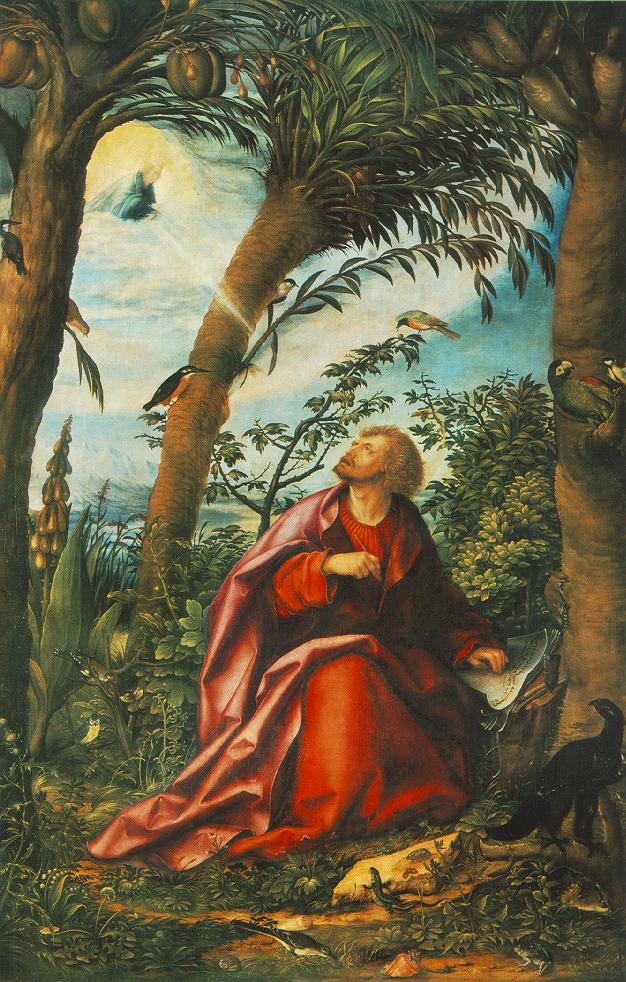
The Book of Revelation is a translation into visual images and symbolic language of the truths grasped by faith. John knows that creation in its entirety has always been ordered towards the Incarnation. Its order and intelligibility are due not to its being a pale imitation of the One, but to the presence within it of the God-Man. This presence is brought about by an action, by God’s willing to give himself both in eternity and in time – and the latter intention necessitates the creation. The universe is grounded in the freedom of love. The wellspring of this Johnannine tradition, that flows down through the Letters and Revelation through to mystical writers such as Dionysius and Eriugena, is to be found in the Prologue to John's Gospel and the Farewell Discourses, where Jesus speaks of the overcoming of the world and his own glorification, the indwelling of the Son in the Father and of the believers in the Trinity.

John Scotus Eriugena describes faith using another metaphor, based on Jesus's words in Scripture. Faith is a seed, like a mustard seed, "a certain principle from which knowledge of the Creator begins to emerge in rational nature." Faith is not an alternative to knowledge, but the beginning of a certain mystical knowledge or experience of God, which leads to him as it matures. It is the awakening of the supernatural life of the soul, the seed of the fruit of the Word. See his commentary on the Prologue in The Voice of the Eagle.

(Readers may also be interested in the very fine philosophical and textual commentary The Beginning of the Gospel of John by James R. Mensch, which is available online minus the Greek.)